EU FUNDED
FP7 PROJECT FLOODSAT (277183)


The overarching objective of
the FLOODSAT project is to advance the utility of satellite-based
precipitation estimates for hydrologic modeling, specifically for flood
monitoring. The main objectives include evaluation of the
satellite-based precipitation (SBP) products over the Western Black Sea Region
in Turkey using the rain gauge network (Figure 1), devising a bias-adjustment
algorithm for the SBP products and implementation of a hydrologic model in a
selected watershed. An improved methodology for calibration and
evaluation of the hydrological model utilizing streamflow observations measured
at the outlet and interior points will be devised. The performance of the hydrologic
model driven by satellite-based and ground-based observations will provide
further insights into the value of existing and adjusted satellite-based
precipitation estimates for basin-scale streamflow simulations.
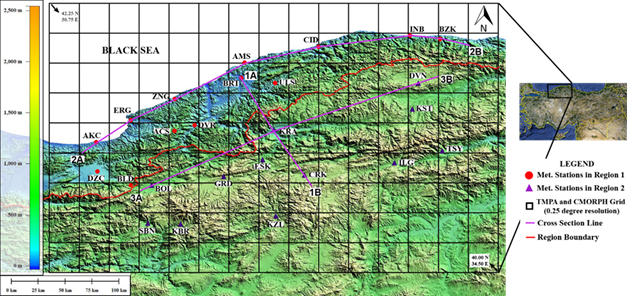
Figure 1. Western Black Sea Region, Turkey.
Meteorological stations within windward side of mountains are marked by a “dot
marker” and those within leeward side are marked by a “triangle marker”.
The Satellite-based precipitation (SBP) products utilized in this study include The Tropical Rainfall Measuring Mission (TRMM) Multi-satellite Precipitation Analysis (Version 7) including real time (TMPA-7RT) and gauge adjusted (TMPA-7A) products; Climate Prediction Center Morphing Technique (CMORPH) and the Multi Sensor Precipitation Estimate (MPE) of the European Organization for the Exploitation of Meteorological Satellites (EUMETSAT). The study area is characterized by a complex topography, marked by Northeast-Southwest aligned mountain ranges running parallel to the shoreline. Hence orographic precipitation is very characteristic at the windward (North) side of the mountains. A rain gauge-based gridded precipitation product was constructed considering the “physiographic similarity” concept in which a locally weighted linear rainfall-elevation relationship was used for precipitation estimation at 0.05o grids. The weights of the rain gauges were established using a combination of a set of physiographic descriptors including distance, elevation, coastal proximity, facet and effective terrain height.
Evaluation of the SBP products indicated that the orographic controls on the precipitation influences the performance of the SBP products (Figure 2). Evaluated SBP products generally had difficulty in representing the precipitation gradient normal to the orography. TMPA-7RT, TMPA-7A and MPE products underestimated precipitation along the windward region and overestimated the precipitation on the leeward region, more significantly during the cold season. CMORPH product underestimated the precipitation on both windward and leeward regions regardless of the season. Further investigation of the datasets used in the development of these SBP products revealed that, although both infrared (IR) and microwave (MW) datasets contain potential problems, inability of MW sensors to detect precipitation especially in cold season was the main challenge over this region with complex topography.
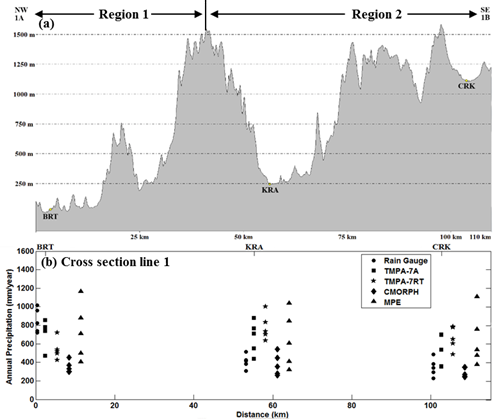
Figure 2. (a)
Topographic elevations, (b) annual precipitation for each SBP product and rain
gauge along cross section line 1.
A new bias adjustment methodology (BAPS) for the
satellite-based precipitation products has been devised based on the
“physiographic similarity” concept. In the proposed
procedure, SBP estimates are adjusted based on a weighted scheme using rain
gauges. Rain gauge weights were calculated based on physiographic similarity
concept which is more suited to the complex terrain as opposed to the commonly
used proximity concept. Comparison
of SBP products before and after bias adjustment with BAPS algorithm indicated
that the adjustment procedure successfully corrected for the precipitation
detection problems. The bias adjustment procedure resulted in significant improvements
in the performance of the CMORPH and MPE products with less significant
improvements in TMPA-7RT product showing high spatial heterogeneity in
precipitation estimates (Figure 3). Comparison of the BAPS algorithm with the baseline
Inverse Distance Weighted Algorithm (IDW) using two independent stations showed
that the BAPS algorithm generally provided better statistics.
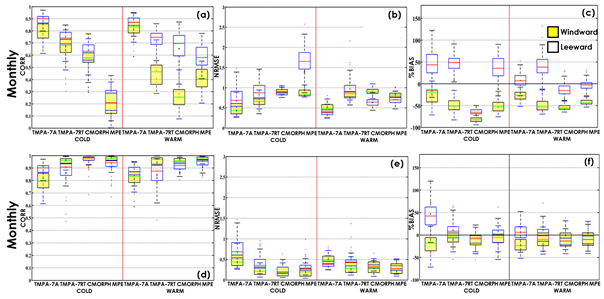
Figure 3. Box-plots
showing seasonal monthly statistical results calculated between RGP grids in
windward (Yellow box) and leeward (White box) regions and co-located SBP
products before bias adjustment (a-c) and after bias adjustment (d-f). Note
that TMPA-7A already includes rain gauge information and hence has not been
adjusted.
A coupled distributed hydrological model, MIKE-SHE/MIKE-11 was
implemented for the Karabük Basin located within the study area (Western Black
Sea Basin of Turkey). Streamflow is
observed at two stations in the Karabük Basin, at the outlet and at an interior
location marking the outlet of the Araç Subbasin (Figure 4). A
novel model calibration strategy has been devised that builds on the signature
measure approach. In the proposed strategy, model parameters
controlling different hydrological processes are grouped and constrained in a
hierarchical, step-wise manner using signature measures sensitized to extract
streamflow information relevant to the focused hydrological process in each
step. The calibration procedure starts with random sampling of parameter sets
from the feasible parameter space and calculation of signature measures
extracted from streamflow observations.
The procedure follows a bottom-up hierarchical order in the soil column
where parameters controlling the groundwater component (baseflow) are
constrained first using the selected low flow signature measure. In a hierarchical,
step-wise procedure, parameters controlling interflow, unsaturated flow,
overland flow and channel flow are constrained using signature measures
selected for the focused hydrological process in each step. In the final stage
of the hierarchical constraining procedure, a parameter set that provides the
best performance in terms of all signature measures was selected and tested
within the evaluation period. The proposed calibration strategy was first
utilized in the interior Arac sub-basin using the RGP
dataset. The MIKE-SHE/MIKE-11 model with
the parameter values calibrated using
the RGP dataset was then utilized to evaluate the value of satellite-based
precipitation products (before and after bias adjustment) for streamflow
simulation. It was found that the errors in the satellite-based precipitation
products directly translates into the simulated flows, indicated by
overestimation of flows when the model was driven by TMPA products and
underestimation of flows when the model was driven by CMORPH product. Bias
adjustment using the proposed BAPS algorithm improved the flow simulation
performance significantly. It also was found that the model performance did not
improve significantly when the model parameters were re-calibrated using
satellite-based products instead of using RGP-calibrated parameters (Figures 5
& 6). These results indicated that bias adjustment of satellite-based rainfall
products using relatively sparse raingauge network will improve the hydrologic
model performance in simulating flood events in the study area.
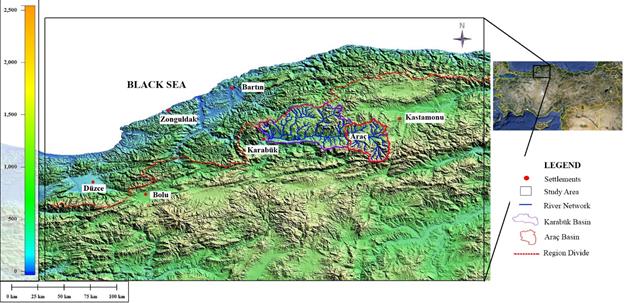
Figure
4. Karabük and Araç Basins in which the MIKE-SHE/MIKE-11 model was implemented.
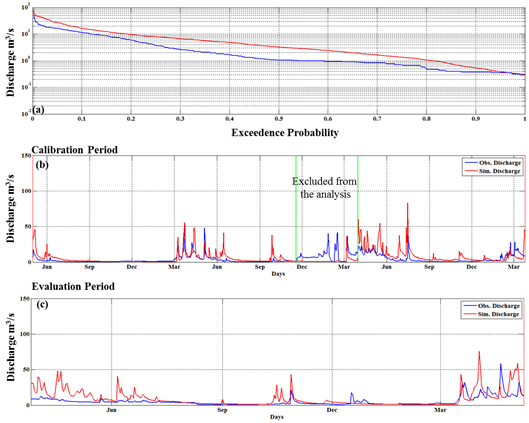
Figure 5. Simulated and observed (a) Flow duration
curve and (b) hydrograph during calibration period and (c) hydrograph during
evaluation period for RGP-calibrated model driven by TMPA-7RT BAPS in Arac
Basin.
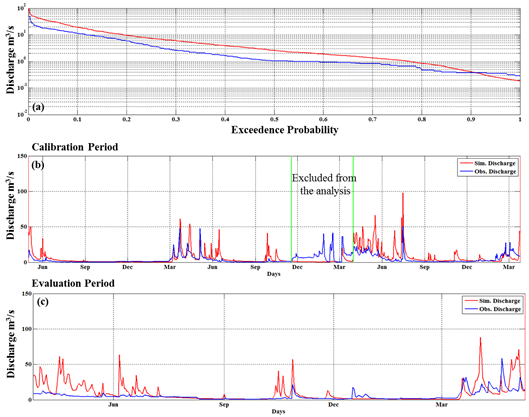
Figure 6. Simulated and observed (a) FDC and (b) hydrograph
during calibration period and (c) hydrograph during evaluation period for TMPA-7RT
BAPS -calibrated model
driven by TMPA-7RT BAPS product in Arac Basin.
In an effort to check the model parameter transferability for the
ungauged basins within the study area, the parameter set
calibrated for the Arac Basin was transferred to and evaluated for the
downstream Karabuk Basin. It was found that the model with the transferred
parameters are able to adequately capture the high streamflow events.
At the
international level, the project resulted in two important advancement
beyond the state of the art. First, a bias adjustment algorithm for
satellite-based precipitation estimates (BAPS) has been devised based on the ‘Physiographic similarity’ concept which is
well-suited to regions with complex topography with relatively sparse raingauge
network. Bias adjustment algorithms in the literature generally rely on the
proximity concept and is not suited to topographically complex regions where
topographic features significantly impact the precipitation patterns at short
distances. Second, a novel model calibration strategy has been devised that
builds on the signature measure approach. In the proposed strategy, model
parameters controlling different hydrological processes are grouped and
constrained in a hierarchical, step-wise manner using signature measures
sensitized to extract streamflow information relevant to the focused
hydrological process in each step. The calibration procedure starts with random
sampling of parameter sets from the feasible parameter space and calculation of
signature measures extracted from streamflow observations. The procedure follows a bottom-up
hierarchical order in the soil column where parameters controlling the groundwater
component (baseflow), interflow, unsaturated flow, overland flow and channel
flow are constrained sequentially using signature measures selected for the
focused hydrological process in each step. The use of signature measures, and
parameter constraining based on sensitivity analysis are the main advancements
beyond the current state of the art in the field of parameter estimation.
Project Duration: April 2011-March 2014
Publications:
Derin, Y. and Yilmaz, K.K., 2014: Evaluation of
Multiple Satellite-Based Precipitation Products over Complex Topography,
Journal of Hydrometeorology, 15 (4), 1498-1516. doi:10.1175/JHM-D-13-0191.1
Derin, Y. and Yilmaz, K.K., (in preparation): Bias
Adjustment Methodology for Satellite-Based Precipitation Products Over Complex
Terrain Based on the concept of Physiographic Similarity. (Draft manuscript
attached as Annex)
Derin, Y. and Yilmaz, K.K., (in preparation): A
process oriented sequential constraining approach to model evaluation.
Derin, Y. and Yilmaz, K.K., (in preparation): The
utility of satellite-based precipitation products for hydrologic modeling: Is
bias adjustment necessary?
Scientific
Conferences - Oral:
Yilmaz K. K. and Derin, Y., (2014). Advancement of Satellite-based Rainfall Applications
for Hydrologic Modeling in Topographically Complex Regions, European
Geosciences Union General Assembly, Vienna, Austria, 27 April – 2 May 2014, Geophysical
Research Abstracts Vol. 16, EGU2014-13462, 2014
Derin,
Y., Yilmaz, K. K., Physically-Based Integrated Hydrologic Modeling in Araç
Basin, 67th Geological Congress of Turkey, Ankara, Turkey, 14-18 April 2014.
Derin,
Y., Yilmaz, K. K., Evaluation and Bias Adjustment of Multiple Satellite-Based
Rainfall Products over Complex Terrain, 67th Geological Congress of Turkey, Ankara,
Turkey, 14-18 April 2014.
Scientific
Conferences - Poster:
Yilmaz K.K., and Derin, Y., Advancement of
Satellite-based Rainfall Applications for Hydrologic Modeling in
Topographically Complex Regions, In American Geophysical Union Fall Meeting,
San Francisco, USA, 9 – 13 December 2013.
Yilmaz,
K. K., Derin, Y., Evaluation and Bias Adjustment of Multiple Satellite-Based
Rainfall Products over Complex Terrain, Geology and Remote Sensing Symposium,
13-14 March 2014, Akdeniz University, Antalya, Turkey (in Turkish).
Derin,
Y. and Yilmaz K.K., Evaluation of Multiple Satellite-based Rainfall Products
over a Topographically Complex Watershed, European Geosciences Union General
Assembly, Vienna, Austria, 22 – 27 April 2012.
Derin,
Y. and Yilmaz K.K., Evaluation and Bias Adjustment of Multiple Satellite-based
Precipitation Products over Complex Terrain, European Geosciences Union General
Assembly, Vienna, Austria, 7 – 12 April 2013.
Awards:
Ms. Derin (graduate student funded by FLOODSAT
Project) received the prestigious “Hydrological Sciences Outstanding Student
Poster Award” at European Geosciences Union General Assembly held in April
2013.
Ms. Derin interviewed by GEOLOG, The Official Blog
of the European Geosicences Union. http://geolog.egu.eu/2013/11/13/geotalk-yagmur-derin-on-posters-and-precipitation/